AI Tools7 min read
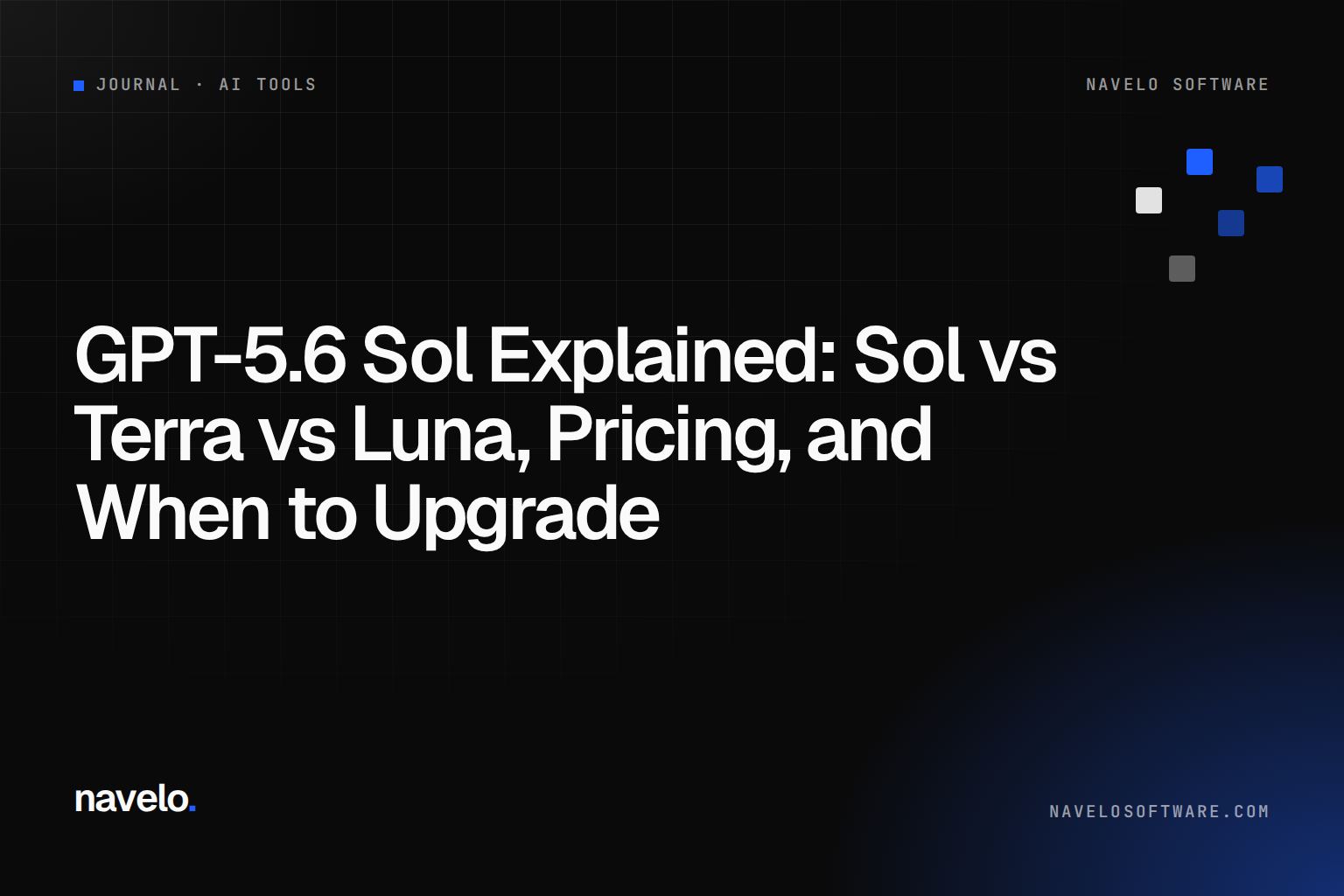
GPT-5.6 Sol Explained: Sol vs Terra vs Luna, Pricing, and When to Upgrade
OpenAI's GPT-5.6 split its flagship into three tiers and made token efficiency the headline. What Sol actually is, how it compares with Terra and Luna, what it costs after two price changes, and whether to move to GPT-6 Sol.
Contents
GPT-5.6 Sol is the flagship tier of OpenAI's GPT-5.6 family, released on 9 July 2026 alongside two smaller tiers, Terra and Luna. It is built for the hardest work: long reasoning, large codebases, computer use and orchestrating other agents. Its selling point is not only capability but efficiency, doing the same work with far fewer tokens.
The model landscape has already moved on: GPT-6 Sol shipped on 22 September, and GPT-6.1 Sol was announced at DevDay on 29 September. This guide explains what GPT-5.6 Sol is, how the tiers differ, what it costs today, and how to decide whether to use it, stay on it or move up.
Sol, Terra and Luna at a glance
| Tier | Positioning | Price (input / output) | SWE-Bench Pro | Best for |
|---|---|---|---|---|
| Luna | Smallest, lowest cost | $1 / $6 at launch; $0.20 / $1.20 after 30 July | 62.7% | High-volume classification, routing, extraction |
| Terra | Balanced default | $2.50 / $15 at launch; $2 / $12 after 30 July | 63.4% | Most product features and internal tools |
| Sol | Flagship for reasoning and agents | $5 / $30 at launch; $4 / $20 promotional | 64.6% | Long agentic tasks, large refactors, computer use |
Two things stand out. First, the tiers are much closer on coding benchmarks than their prices suggest; reviewers such as Vellum and LayerLens recommend Terra as the default for that reason. Second, Sol's lead grows on agentic benchmarks, where reviewers report clear wins on Terminal-Bench, BrowseComp, OSWorld and similar tests of multi-step work.
What makes Sol different: token efficiency
OpenAI's pitch for GPT-5.6 was efficiency rather than raw capability. According to OpenAI's developer announcements, Sol uses around 54% fewer output tokens for equivalent work, which roughly halves output cost for the same result. On the Artificial Analysis Coding Agent Index, Sol at maximum reasoning was reported to set a new high of 80, while using fewer than half the output tokens of the next model and finishing tasks faster.
Why this matters more than a headline benchmark: in agent workflows the cost is driven by how many tokens a model burns to finish, including retries. A cheaper-per-token model that needs three attempts can cost more than an expensive one that succeeds first time. That is why we recommend measuring cost per completed task, as explained in how to measure AI automation ROI.
Pricing: what GPT-5.6 Sol costs now
- Launch (9 July): Sol $5 input / $30 output per million tokens, unchanged from GPT-5.5.
- 30 July: Luna cut about 80% to $0.20 / $1.20 and Terra cut 20% to $2 / $12. Sol's headline price did not move, but a fast mode was added at twice the price for about 2.5 times the speed.
- Promotional Sol pricing: $4 input / $20 output, reported to run at least until 21 November 2026, per OpenAI's community announcement.
- Successor: GPT-6 Sol (22 September) costs $2 / $10, about half of GPT-5.6 Sol's promotional price, according to The New Stack.
Where Sol is worth paying for
- Large, cross-file code changes: restructuring modules, scaffolding features that span many files, generating implementation and tests together. See AI coding agents for software teams.
- Long-running agents: tasks with many tool calls where each mistake compounds, such as research, account investigations or operations work.
- Orchestrator roles: the model that plans and delegates in a multi-agent design, while cheaper tiers do the specialist steps. See MCP vs A2A.
- Very long context: reading a large codebase, contract set or document bundle in one pass.
Where it is not
- Classification, routing and field extraction, where Luna or Terra are close in quality at a fraction of the cost.
- Short drafting tasks and chat replies with retrieval, where latency matters more than depth.
- Any workflow you have not evaluated. A bigger model does not fix unclear instructions or missing data.
A simple model-routing pattern
- 01Classify each request with the cheapest tier that is accurate enough on your test set.
- 02Send routine work (extraction, formatting, short answers) to Luna or Terra.
- 03Escalate only long, multi-step or high-stakes tasks to Sol or GPT-6 Sol.
- 04Log cost and outcome per task and review monthly; move steps down a tier when quality holds.
In our experience this pattern cuts spend substantially without users noticing a quality change. It also makes model upgrades, like the move to GPT-6 Sol, a controlled experiment rather than a leap of faith.
Should you move to GPT-6 Sol?
For new builds, start on GPT-6 Sol (see our GPT-6 Sol guide): it is newer and roughly half the price. For production workloads on GPT-5.6 Sol, run your evaluation set on both, compare quality and cost per completed task, and migrate step by step, keeping GPT-5.6 Sol as a fallback while the promotional pricing lasts. The broader question of which platform to build on is covered in build vs buy for AI agents, and the full rollout approach in the AI automation guide.
Sources and further reading
Frequently asked questions
What is GPT-5.6 Sol?
GPT-5.6 Sol is the most capable tier of OpenAI's GPT-5.6 model family, released on 9 July 2026. It is aimed at complex reasoning, advanced coding, agentic tasks and multi-agent orchestration, and offers a context window of roughly one million tokens.
What is the difference between Sol, Terra and Luna?
They are three sizes of the same generation. Luna is the smallest and cheapest, suited to high-volume simple tasks. Terra is the balanced middle tier and the practical default for most teams. Sol is the flagship, strongest on long agentic tasks, terminal and computer use, and hard reasoning.
How much does GPT-5.6 Sol cost?
Sol launched at $5 per million input tokens and $30 per million output tokens. OpenAI then introduced promotional pricing of $4 input and $20 output, reported to run at least until 21 November 2026. Check OpenAI's pricing page for current rates before budgeting.
Is GPT-6 Sol better than GPT-5.6 Sol?
GPT-6 Sol, released on 22 September 2026, is newer and cheaper at $2 input and $10 output per million tokens, about half of GPT-5.6 Sol's promotional price. For new projects it is usually the better starting point, but test it on your own evaluation set before migrating production workloads.
Should I use Sol for everything?
No. Most tasks, such as classification, extraction and drafting, run well on a cheaper tier. Route simple steps to Luna or Terra and reserve Sol, or its successor, for the hard, multi-step parts of a workflow. Model routing is often the largest single saving in an AI budget.
Work with Navelo Software
Published by Navelo Software
An independent software and AI studio building AI systems, web platforms, mobile apps and SaaS for clients worldwide.